The decision in practical terms
PureVPN is cheaper: $58.20 against Surfshark’s $67.23 for the same 27 months, and $47.95 against $79.00 a year at renewal. Surfshark documents more coverage: unlimited simultaneous devices, Bypasser routing for Mac apps and iPhone websites, and a Kill Switch on iOS, none of which PureVPN documents.
- Choose Surfshark if you’ll connect more than 10 devices at once, need to keep a Mac app or an iPhone website outside the VPN, or want a kill switch on iPhone.
- Choose PureVPN if the bill comes first, if you want include-or-exclude app rules on a Fire TV, or if you need port forwarding, which PureVPN documents as an add-on (Surfshark’s wasn’t checked).
This comparison uses official documentation and price quotes checked on 13 October 2026. We have not tested either service for speed, leaks, streaming or usability.
| Compare |  |  |
|---|---|---|
| Selected plan | Starter | Standard |
| Initial payment · USD | $67.23 | $58.20 |
| Initial months | 27 | 27 |
| Monthly equivalent | $2.49 (upfront plan) | $2.16 (upfront plan) |
| Quoted renewal | $79.00 / 12 months | $47.95 / 12 months |
| Simultaneous devices | Unlimited | 10 |
| Split tunneling | Windows, Android and supported macOS apps/sites. iOS websites only; Linux Bypasser not listed. | Windows app rules; include or exclude apps on Android, Android TV and Fire TV. No documented Mac, iPhone or Linux split tunneling. |
| Refund policy | 30-day initial-purchase guarantee; renewal payments are excluded under the stated policy. | 31-day initial-purchase guarantee; renewals, trial conversions, crypto and app-store purchases are excluded. |
| Details | Surfshark review Offer and sources | PureVPN review Offer and sources |
USD quotes checked 13 October 2026, before applicable tax. Currency, campaign and checkout prices can vary. Monthly rates are equivalents of upfront payments. How pricing works.
The bills: first payment, renewal and 39 months
Both selected plans run 27 months (2 years + 3 months). Surfshark Starter costs $67.23 upfront and PureVPN Standard $58.20, so PureVPN is $9.03 less. The monthly equivalents are $2.49 ($67.23 ÷ 27) and $2.16 ($58.20 ÷ 27 = $2.156; PureVPN’s pages truncate it to $2.15).
The renewal gap is wider. Surfshark Starter renews at $79.00 a year and PureVPN Standard at $47.95, $31.05 less. Keep either through one renewal and 39 months cost $146.23 with Surfshark ($67.23 + $79.00) and $106.15 with PureVPN ($58.20 + $47.95), a difference of $40.08.
All amounts are USD before tax, and tax can change the total: Surfshark’s US checkout from a New York location showed $73.20 due for the $67.23 plan, including $5.97 in sales tax. PureVPN’s US order summary showed no tax line, but tax at payment wasn’t verified. Surfshark runs price tests on some plans and terms, but its Starter 27-month price and annual renewals were the same in every test group checked.
The bundles differ too. Surfshark One costs the same $67.23 for 27 months but renews at $99.00 a year, adding antivirus and scam protection; PureVPN Plus costs $73.80 for 27 months, renews at $69.95 a year and adds a password manager.
Unlimited devices or 10
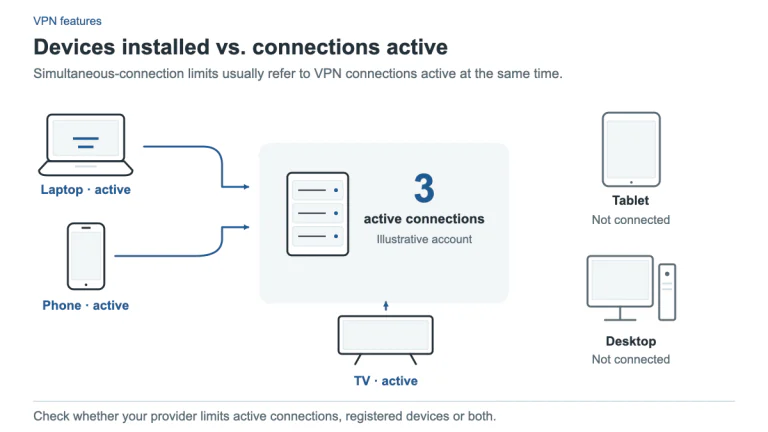
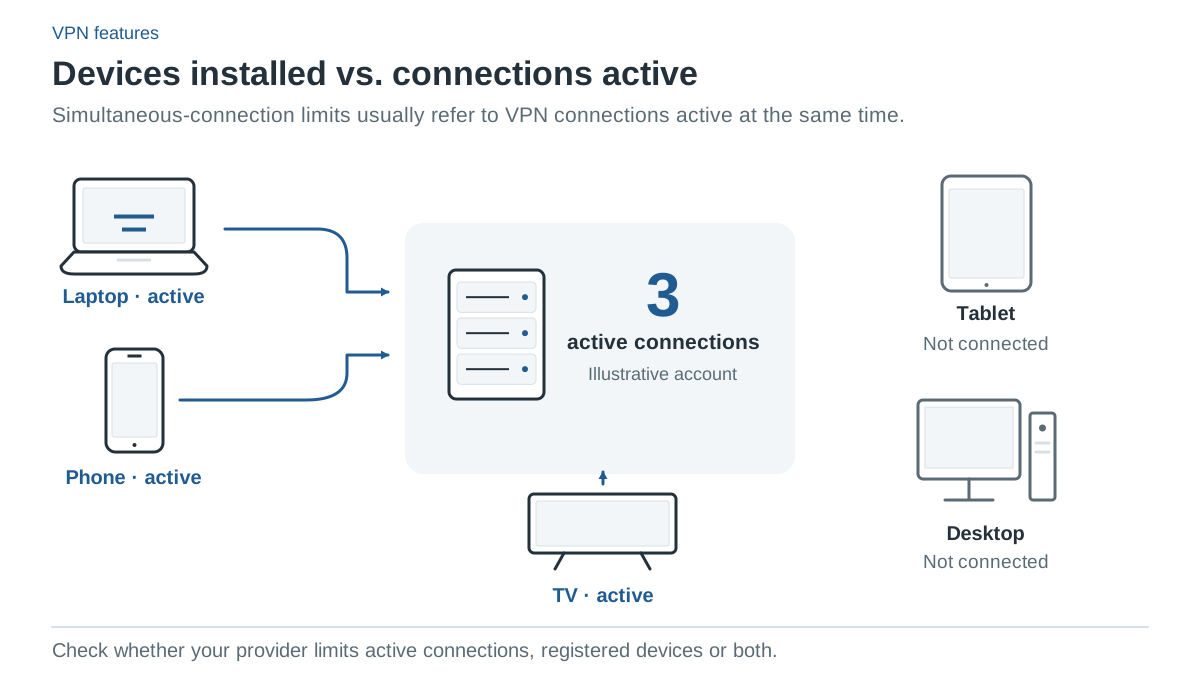
Surfshark lists “Unlimited devices” on every plan; its free trial is limited to 3. PureVPN allows 10 simultaneous connections per account on every plan. One PureVPN help article adds “from the same country”, and its Multi Login add-on (“up to 50+ devices”) costs extra. Count devices connected at the same time rather than devices you own: in a larger household, phones, laptops, TVs and a console online together can pass 10.
Bypasser or PureVPN split tunneling
Surfshark’s Bypasser supports apps and websites on Windows, Android and macOS, and a Surfshark support article adds Android TV to its app-bypassing list. On iOS it excludes websites, not apps. Reverse Bypasser, which sends only chosen traffic through the VPN, covers apps and websites on Android and apps on Windows. Linux isn’t listed. Mac Bypasser needs macOS 12 or later (Big Sur isn’t supported) and approval of a system extension.
PureVPN documents app split tunneling on Windows, where the apps you list use the VPN, and on Android, Android TV, Fire TV and Huawei, with “Allow only selected apps to use VPN” and “Do not allow selected apps to use VPN” modes. It documents none on Mac, iPhone or Linux. Its browser extensions have a website “Bypass Proxy” list that applies to the browser only.
In practice:
- A Mac app outside the VPN: Surfshark.
- An iPhone website outside the VPN: Surfshark. Neither documents iPhone app exclusions.
- Fire TV app rules: PureVPN documents include and exclude modes; Surfshark’s app-bypassing list doesn’t name Fire TV.
- Linux: neither documents app split tunneling.
Kill switches
Surfshark documents its Kill Switch on Windows, macOS, Android, iOS and Linux. Its feature page describes a soft mode for unexpected disconnections and a strict mode that blocks traffic whenever the VPN is off, including after a manual disconnect; the setup guide shows only an on/off switch, so check which mode your app offers.
PureVPN documents its Internet Kill Switch on Windows, Mac and the Linux GUI app, for connection drops only, and points Android users to the system’s Always-on VPN with “Block connections without VPN”. No kill switch is documented for iPhone, Android TV or Fire TV, and the default setting isn’t stated. For iPhone users, this is the clearest documented gap between the two.
Refunds, trials and cancellation
Surfshark’s 30-day guarantee covers the initial purchase, with one refund per service, and excludes recurring payments; refunds are requested through live chat. Its website trial costs $0.00 for 7 days, with payment details required, and then charges $67.23 for 27 months; the 30-day guarantee starts at that charge, “giving you a total of 37 days”.
PureVPN gives 31 days from the initial purchase and excludes renewals, trial conversions, App Store and Google Play purchases, and crypto, CoinGate, PayGarden and gift-card payments. Its website trial costs $0.99 and converts to $47.95 for 12 months, a charge that is non-refundable.
To stop renewal, Surfshark uses account → Subscription → Payments → Cancel auto-renewal, and PureVPN uses Member Area → Subscriptions → Cancel Subscription. Neither step requests a refund.
Trust records
Surfshark cites Deloitte no-logs assurance reports from 2023 and 2025, the later one covering standard, static and multiport servers under ISAE 3000; the full reports are in the user account, and we haven’t read them. Its trust center lists security audits including Cure53’s March 2026 assessment of its Dausos protocol and a December 2025 SecuRing infrastructure test that found no critical vulnerabilities and one medium-risk one. Its terms say a user ID or IP address and connection timestamps are kept for abuse prevention and “automatically deleted within 15 minutes after termination of your session”. Surfshark B.V. is a Dutch company, and Surfshark merged with Nord Security in 2022 under one holding company while operating independently.
PureVPN has the 2017 case: according to the FBI affidavit quoted by TorrentFreak, PureVPN “was able to determine that their service was accessed by the same customer from two originating IP addresses”, the suspect’s home and his employer. PureVPN said it “acted precisely as per our existing Terms of Service and Privacy Policy”. It has since cited an Altius IT audit, a 2020 audit whose post is titled for KPMG but now names only a “Well known audit firm”, and a February 2023 assessment. PureVPN is operated by GZ Systems Limited, a British Virgin Islands company whose owners aren’t stated on official pages.
The PureVPN review and the Surfshark review cover each record in more detail.
Our recommendation by need
- More than 10 devices at once: Surfshark.
- Mac app or iPhone website routing: Surfshark.
- A kill switch on iPhone: Surfshark.
- Lowest bill and renewal: PureVPN, by $9.03 for the first 27 months and $31.05 a year at renewal.
- Fire TV app rules: PureVPN.
- Port forwarding or a dedicated IP: PureVPN sells both as add-ons. Surfshark sells a Dedicated IP from $3.75 a month; its port forwarding wasn’t checked for this page.
Surfshark Starter: $67.23 today for 27 months, then $79.00 every year.
Opens Surfshark’s site · 30-day money-back guarantee on eligible first purchases
PureVPN Standard: $58.20 today for 27 months, then $47.95 every year.
Opens PureVPN’s site · 31-day money-back guarantee on eligible first purchases
Before paying, check the full totals in the Surfshark offer guide or the PureVPN offer guide.
Common questions
Is PureVPN cheaper than Surfshark?
Yes, on the selected plans: $58.20 against $67.23 for 27 months, and $47.95 against $79.00 a year at renewal. Over 39 months that’s $106.15 against $146.23, before tax.
Which one works on more devices at once?
Surfshark, which lists unlimited simultaneous devices. PureVPN allows 10 per account and sells a Multi Login add-on for more.
Does either have split tunneling on Mac or iPhone?
Surfshark’s Bypasser covers Mac apps and websites on macOS 12 or later, and websites, not apps, on iPhone. PureVPN documents no split tunneling on Mac or iPhone.
Sources and check date
Official sources checked 13 October 2026. Provider terms, app releases and localized offers can change. Documented features are not independent test results.
- Surfshark: Plan options (One and One+)
- Surfshark: Kill Switch modes
- Surfshark: Bypasser on macOS
- Surfshark: macOS requirements
- Surfshark: App bypassing platforms (no iOS apps)
- Surfshark: 7-day free trial (affiliate link)
- Surfshark: Free trial support article
- Surfshark: Deloitte no-logs assurance (2023)
- Surfshark: Deloitte no-logs assurance (2025)
- Surfshark: Trust center (security audits)
- Surfshark: Terms of Service (logging, contracting entity)
- Surfshark: About us (Nord Security merger)
- Surfshark: Dedicated IP: surfshark.com/dedicated-ip
- PureVPN: Order page behind the offer link (add-ons) (affiliate link)
- PureVPN: Same-country device note
- PureVPN: Android TV split tunneling
- PureVPN: Fire TV split tunneling
- PureVPN: Huawei split tunneling
- PureVPN: Browser extensions are proxies
- PureVPN: Mac kill switch
- PureVPN: Linux kill switch
- PureVPN: Android Always-on VPN
- PureVPN: iOS app settings
- PureVPN: $0.99 7-day trial (affiliate link)
- PureVPN: Refundable and non-refundable payment methods
- PureVPN: Altius IT audit post
- PureVPN: 2020 audit post (titled for KPMG)
- PureVPN: February 2023 no-log assessment
- PureVPN: Response to the 2017 case
- TorrentFreak (third-party): FBI affidavit report, 9 October 2017
- PureVPN: Terms of Service (company)
- Surfshark: Pricing (affiliate link)
- Surfshark: Billing and renewal prices
- Surfshark: Unlimited devices
- Surfshark: Bypasser platform coverage
- Surfshark: Kill switch setup
- Surfshark: Refund policy
- Surfshark: Cancel auto-renewal
- PureVPN: Plans, prices and renewal statements (affiliate link)
- PureVPN: Renewal prices
- PureVPN: 10 devices
- PureVPN: Supported apps
- PureVPN: Split tunneling platforms
- PureVPN: Windows split tunneling
- PureVPN: Android split tunneling
- PureVPN: Kill switch (Windows)
- PureVPN: Refund policy
- PureVPN: Cancel auto-renewal