 36-month deal
The PrivateVPN deal in actual money
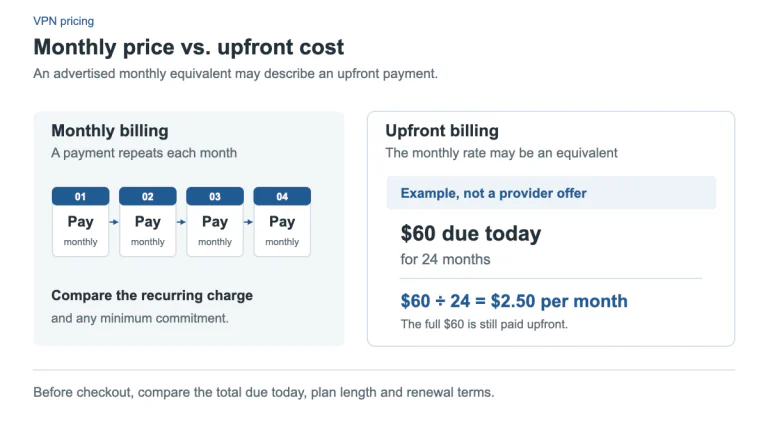
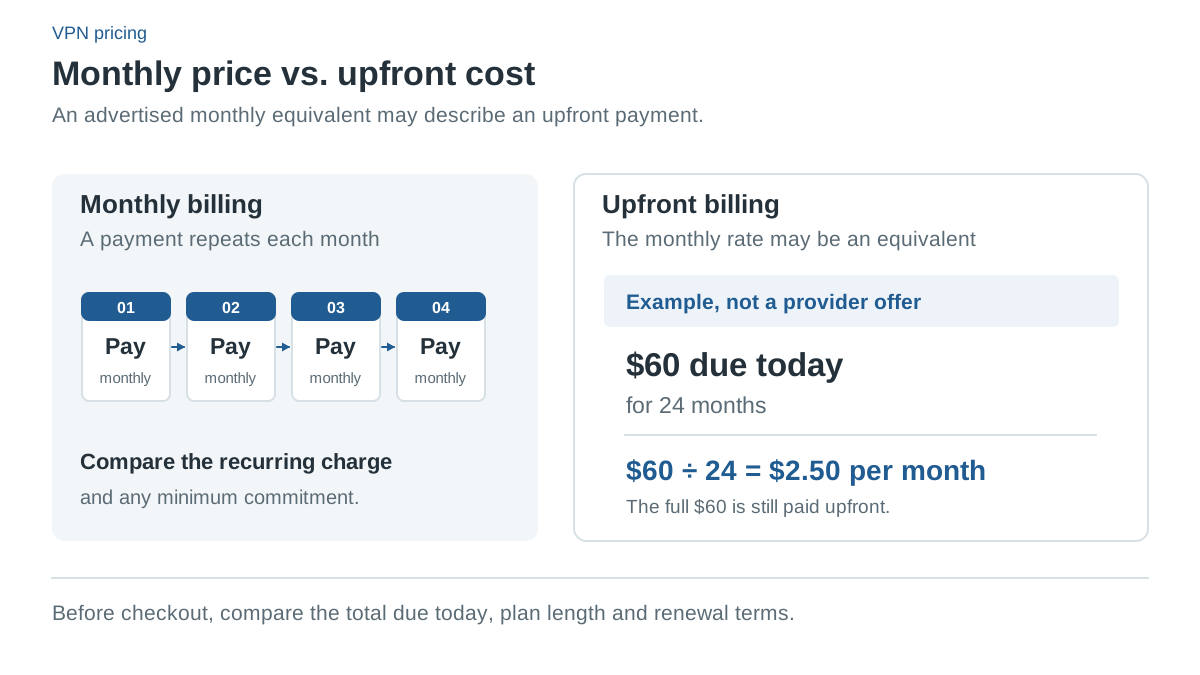
You don’t need a PrivateVPN coupon code for the current deal. On 13 October 2026, PrivateVPN’s own pricing page, with USD selected, offered its 36-month plan, sold as “12 Months + 24 Months extra”, for $72.00 paid upfront. Dividing the payment by the months it covers gives the advertised rate: $72.00 ÷ 36 = $2.00 a month. That $2.00 is a monthly equivalent; PrivateVPN collects the full $72.00 at checkout.
The discount takes the form of bonus time, and the renewal shows it. PrivateVPN’s plan card states “(72.00 USD billed every 12 months after 36 months)”. The second payment therefore arrives after month 36 and buys one year, not three: $72.00 ÷ 12 = $6.00 a month in each renewal year. If you keep the plan through its first renewal, you pay $72.00 + $72.00 = $144.00 for 48 months, an average of $3.00 a month.
Treat that renewal as a quoted figure rather than a promise. The card sentence is generated from the same price field as the first payment, and PrivateVPN publishes no separate renewal table. Its Terms say subscriptions renew automatically for the same length as the billing term, which is 12 months here, and that fee changes take effect at renewal after “reasonable advance notice”. We did not make a purchase to confirm the renewal charge.
PrivateVPN labels its prices “incl. VAT”, and choosing the United States as tax residence left the order total at 72.00 USD; we did not reach the payment step, so we can’t confirm whether US sales tax is added there. The page calls the deal a “LIMITED OFFER” but shows no end date, so this page has no countdown.
Every PrivateVPN plan and price
| Plan and term | Paid today | Monthly equivalent | Then renews at |
|---|---|---|---|
| PrivateVPN12 months + 24 months extra | $72.00 for 36 months | $2.00/mo | $72.00 every year |
| PrivateVPN3 months | $17.99 for 3 months | $6.00/mo | $17.99 every 3 months |
| PrivateVPN1 month | $9.90 for 1 month | Monthly billing | $9.90 every month |
USD quotes checked 13 October 2026, before applicable tax. Currency, campaign and checkout prices can vary. Monthly rates are equivalents of upfront payments. How pricing works.
PrivateVPN sells one service in three billing lengths. Its pricing page says every plan includes all PrivateVPN apps, 24/7 customer support and unlimited bandwidth, so a longer term changes the price and the commitment, not the features. The 3-month plan collects $17.99 ($17.99 ÷ 3 = $6.00 a month, rounded), and the 1-month plan collects $9.90. Each card says it bills the same amount again at the end of its term.
At the card prices, paying monthly for three years would cost 36 × $9.90 = $356.40, and twelve 3-month payments would cost 12 × $17.99 = $215.88, against $72.00 for the 36-month plan. Both short plans also fall below the USD 45 refund minimum explained below.
The “SAVE 85%” style badges on the cards are PrivateVPN’s campaign labels, so we don’t treat them as calculated savings. If you see “Plans start at $12 per month” in PrivateVPN’s help-center FAQ, that line conflicts with the live pricing page, which showed $9.90 for one month on 13 October 2026.
How to buy PrivateVPN at the quoted price
- Open the PrivateVPN offer (affiliate link) and confirm the address is privatevpn.com before you enter anything.
- Check the currency next to the prices. PrivateVPN picks a currency from your location and offers a “Selected currency” menu. The $72.00 quote is for USD; from Europe the same plan showed 75.00 EUR, which is a separate price list, not a conversion.
- Select the 36-month card (“12 Months” struck through, then “36 Months”), labeled “Most popular” and normally preselected, and confirm the order total reads 72.00 USD.
- Choose your tax residence and payment method, then check the total again. The checkout we viewed offered credit card (through Stripe), PayPal and cryptocurrency (through Coinify). Card and PayPal payments renew automatically by default; a Bitcoin payment doesn’t, and the Terms make cryptocurrency payments non-refundable.
- Complete the account details, which need an email address and a password, and keep the order confirmation. Note the date 36 months ahead, when the first renewal is due.
Buying inside the iPhone app is a different route. PrivateVPN’s Terms exclude App Store purchases from its 30-day guarantee and say App Store prices can differ from the website. PrivateVPN’s partner landing page showed the same three USD prices as its regular pricing page when we opened it directly on 13 October 2026; we did not follow the tracking redirect itself.
What the 36-month plan includes
The plan covers up to 10 devices at the same time. PrivateVPN’s Terms grant one license “on up to 10 different devices at any given time” and suggest a router or a second subscription for more. Older router and Kodi pages still say six devices, but the Terms prevail over other site text, so rely on 10.
PrivateVPN documents apps for Windows (11, 10, 8.1 and 7 SP1), macOS 12 and later, Android, iPhone and iPad, and Amazon Fire TV and Fire Stick; ChromeOS uses the Android app. Its Chrome extension is a proxy, not a full VPN. There is no documented Linux app, only manual guides for OpenVPN, WireGuard and other protocols, and routers also use manual setup guides.
Three features set the plan apart, with no extra charge shown on the pricing page:
- Port forwarding on selected servers. PrivateVPN says availability varies by location, publishes no list of those servers, and warns that the assigned port can change when you reconnect.
- Stealth VPN, a switch in the Windows, Mac, Android and iOS apps that PrivateVPN says is designed to make VPN traffic look like regular internet traffic.
- Dynamic dedicated IP servers in eight cities, including Los Angeles and New York. PrivateVPN doesn’t define “dynamic dedicated”, so don’t assume an address only you use.
The plan doesn’t include split tunneling in the apps; PrivateVPN documents only manual workarounds, such as IP-based WireGuard rules. Its kill switch is a toggle on Windows, Mac and Android, while the iPhone guide relies on the IKEv2 protocol’s built-in kill switch. The PrivateVPN review covers these platform differences in detail.
Refund conditions: the Terms are narrower than the badge
Every PrivateVPN plan card carries a “30-day money-back guarantee” badge, and the pricing banner says all subscriptions are protected by a “100% money back guarantee”. PrivateVPN’s Terms, which say they prevail over conflicting site text, are narrower:
- Orders under USD 45 (SEK 400) are excluded. That rules out the $9.90 1-month and $17.99 3-month plans. The $72.00 36-month plan is above the threshold.
- Renewals are excluded. The money-back page also limits the guarantee to new customers.
- Bitcoin and other cryptocurrency payments are non-refundable.
- App Store in-app purchases don’t get PrivateVPN’s guarantee; refunds there are at Apple’s discretion.
- Changing the order waives the refund, for example upgrading to a longer term or adding licenses.
- You must give a reason. Requests go by email to support@privatevpn.com.
The pages also disagree on timing. The Terms promise repayment no later than 14 days after PrivateVPN is notified, to the original payment method, while the money-back page says refunds are processed within 5 business days of confirmation. The FAQ’s promise of a refund “regardless of the reason” conflicts with the reason requirement, and we found no refund rule for Google Play purchases.
In practice, the purchase that fits the guarantee most cleanly is a first-time 36-month order paid on the website by card or PayPal, with the request sent within 30 days. Our VPN refund guide explains why stopping a renewal and requesting a refund are separate actions.
How to cancel PrivateVPN auto-renewal
- Sign in to your account at privatevpn.com/account/login.
- Click Cancel Subscription. PrivateVPN’s help article says this “will only cancel the auto-renewal feature of your VPN plan”.
The Terms ask you to turn off auto-renewal before the new subscription period begins, so for the 36-month plan, do it before month 36 ends. They also say the agreement expires at the end of the period you paid for, although the help article doesn’t spell out that access continues after you cancel. If you subscribed through the App Store or Google Play, cancel in that store instead.
Don’t delete your account to stop billing: PrivateVPN warns that deleting it forfeits the remaining days. Canceling renewal is not a refund request either; that needs the email described above.
Who the PrivateVPN deal fits
The 36-month plan makes sense if you want a modest upfront bill for a long term, use no more than 10 devices at once, and run Windows, macOS 12 or later, Android, iOS or Fire OS. It is a close documented match if you need port forwarding without buying an add-on, or a Stealth VPN switch for networks that restrict VPN traffic.
It is a weaker fit if you need one app to bypass the VPN, want a Linux app, or want an independently audited no-logs policy: we found no audit cited on PrivateVPN’s official pages. It also suits a short trip poorly, because the 1-month and 3-month plans fall outside the refund terms.
NordVPN Basic collects $94.23 for 27 months and quotes a $139.08 yearly renewal, so PrivateVPN’s quoted bills are lower at both stages. NordVPN, though, documents app split tunneling on Windows and Android and cites independent no-logs assurance. NordVPN vs PrivateVPN sets out the four-year arithmetic, and our cheap VPN comparison lines up the other offers we cover.
PrivateVPN 36-month: $72.00 today for 36 months, then $72.00 every year.
Opens PrivateVPN’s site · 30-day money-back guarantee for new customers; terms apply
Common questions
Is there a PrivateVPN coupon code?
We haven’t verified a public PrivateVPN coupon code, and the current price doesn’t need one: the $72.00 36-month plan appears on PrivateVPN’s own pricing page without a code. A code from a coupon site may not apply or may change the plan, so check the order total and months before paying.
Does the 1-month plan have a refund?
Not under PrivateVPN’s Terms. The refund provision doesn’t apply to amounts below USD 45, so the $9.90 1-month plan and the $17.99 3-month plan fall outside it, even though their cards show a money-back badge. If a refund window matters to you, the 36-month plan is the one above the threshold.
Is PrivateVPN free?
No. The pricing page lists three paid terms and no free plan, and we found no current free trial in PrivateVPN’s help center, Terms or pricing page. One feature page mentions a 30-day gift code from support, but nothing else corroborates it. The money-back guarantee is a refund on an eligible purchase, not a free trial.
Does the 36-month plan renew for another 36 months?
No. PrivateVPN’s plan card says the 72.00 USD charge recurs every 12 months after month 36, and the Terms say the renewal term matches the billing term. The 24 extra months belong to the first term only.
Is there a PrivateVPN Black Friday or lifetime deal?
We found none as of 13 October 2026: no Black Friday 2026 campaign and no lifetime plan on PrivateVPN’s site. If one appears, compare its total and renewal with the figures above.
Sources and check date
Official sources checked 13 October 2026. Provider terms, app releases and localized offers can change. Documented features are not independent test results.
- PrivateVPN: Help-center FAQ (devices, payment methods, starting price)
- PrivateVPN: Privacy policy (account email and password)
- PrivateVPN: Windows app requirements
- PrivateVPN: Mac app requirements
- PrivateVPN: Linux setup guides
- PrivateVPN: Router page that still says six devices
- PrivateVPN: Port forwarding on selected servers
- PrivateVPN: Port may change on reconnect (Transmission guide)
- PrivateVPN: Stealth VPN on the features page
- PrivateVPN: Dynamic dedicated IP locations
- PrivateVPN: Deleting an account forfeits remaining days
- PrivateVPN: Kill switch page with the gift-code mention
- NordVPN: US plans, prices and renewals (affiliate link)
- NordVPN: Split tunneling
- NordVPN: 2025 no-logs assurance engagement
- PrivateVPN: Pricing and renewal (choose USD) (affiliate link)
- PrivateVPN: Terms: renewal, devices and refunds
- PrivateVPN: Supported apps
- PrivateVPN: Split tunneling (manual WireGuard)
- PrivateVPN: Kill switch by platform
- PrivateVPN: Port forwarding
- PrivateVPN: Stealth VPN
- PrivateVPN: Money-back guarantee
- PrivateVPN: Cancel auto-renewal