Our assessment
PureVPN is a paid VPN operated by GZ Systems Limited, a British Virgin Islands company; PureVPN says it launched in 2007. Its documentation earns it a place on a shortlist when price matters: Standard costs $58.20 for the first 27 months and renews at $47.95 a year, every plan allows 10 simultaneous devices, app split tunneling is documented on Windows, Android, Android TV and Fire TV, and port forwarding and dedicated IPs are sold as add-ons.
Three limits come with that:
- Platform gaps. No split tunneling is documented on Mac, iPhone or Linux, and no kill switch on iPhone or the TV apps.
- The 2017 case. According to an FBI affidavit quoted by TorrentFreak, PureVPN linked a customer’s use of its service to his home and work IP addresses. PureVPN says it acted within its terms and privacy policy.
- Unnamed assessors. Apart from an earlier Altius IT audit, the no-log assessments PureVPN cites don’t name the audit firm in their current body text, although one post’s title and web address still say KPMG.
This is a documentation-based review: we did not install or test PureVPN, and ran no speed, leak, streaming or usability tests. It draws on PureVPN’s order pages, terms, help center and trust pages, checked on 13 October 2026, with third-party sources only for the 2017 case.
Pricing and renewal
 Standard deal
- Today $58.20 paid upfront for 27 months
- After 27 months $47.95 renews for another year
- After 39 months $106.15 paid in total if you keep it
USD, before tax · checked 13 October 2026
Opens PureVPN’s site · 31-day money-back guarantee on eligible first purchases
No code to copy. The quoted price needs no code: the button opens PureVPN’s current offer.
Monthly equivalent: $2.16 over the first 27 months, paid as one upfront amount.
Fit check: Up to 10 devices at once. App split tunneling on Windows, Android, Android TV and Fire TV; none documented for Mac, iPhone or Linux.
The offer behind this link can differ from the price we checked, and your total can change with your country, tax and add-ons. Sources for this price
Standard is billed $58.20 upfront for 27 months and renews at $47.95 a year, in USD before tax. Its monthly equivalent is $58.20 ÷ 27 = $2.156, shown here as $2.16; PureVPN’s pages show $2.15 because they cut the figure off rather than round it. One renewal brings the 39-month total to $106.15 ($58.20 + $47.95).
Plus ($73.80, then $69.95 a year) adds a password manager; Max ($95.85, then $84.95) adds data removal, dark web monitoring and an eSIM allowance. A 5-year Standard plan ($129.95 for 60 months) is sold only on PureVPN’s deals pages, and there is no official lifetime plan. The PureVPN coupon guide lists every plan, term and checkout step.
Devices and apps
PureVPN allows 10 simultaneous connections per account on every plan: “you can only have 10 of them connected at the same time”, in its help center’s words. Another help article adds “from the same country”, a condition no other page repeats. A paid Multi Login add-on (“Secure up to 50+ devices with one account”, $1.45 a month on the 2-year tab) raises the limit.
The download page lists apps for Windows, Mac, Linux, Android, iPhone and iPad (iOS 15 or later, per the App Store listing), Apple TV, Android TV, Fire TV, Huawei devices and Chromebook. The Linux app comes in GUI and command-line versions. The Chrome, Firefox and Edge extensions are proxies; PureVPN says the extension “only protects your web browser and nothing else on your device”. Routers need WireGuard or OpenVPN client support.
PureVPN’s servers page, updated 12 October 2026, says “Access 6,000+ servers in 80+ locations across 65+ countries” and names WireGuard, OpenVPN and IKEv2 as protocols. Its feature pages give different counts, “96+ Locations” and “78+ Countries”; the servers page is the newer of the two.
Split tunneling by platform
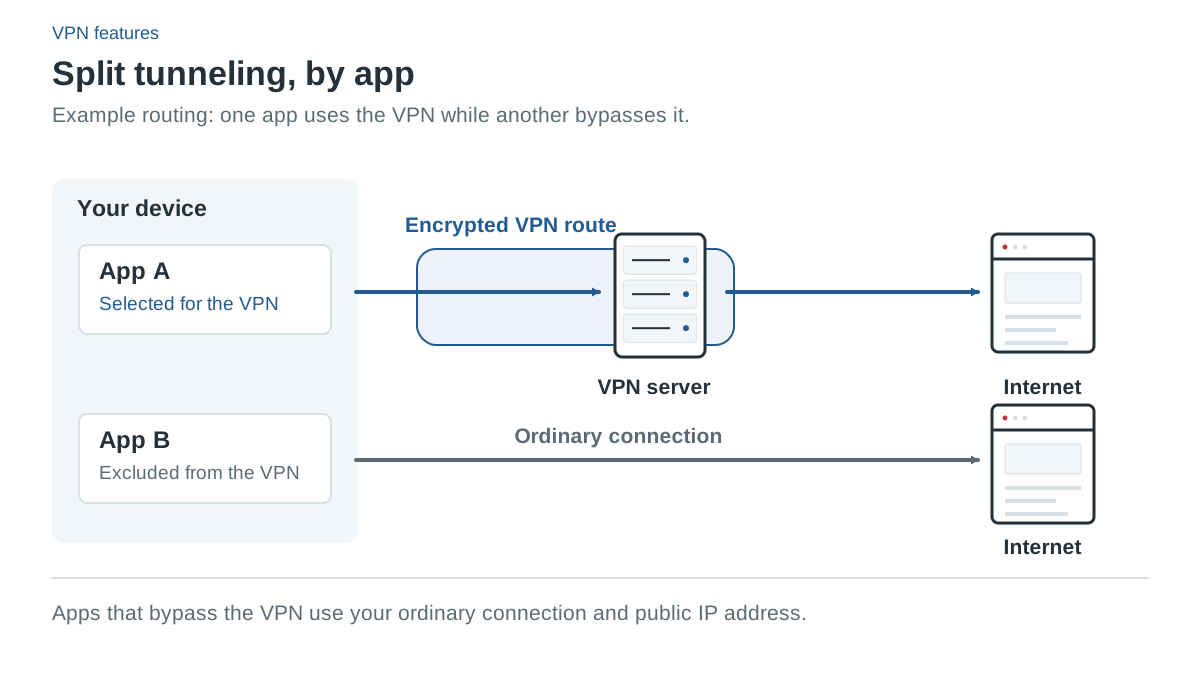
PureVPN’s feature page says split tunneling “is available on Windows, Android, Fire TV Stick, and Android TV devices”. Its help overview names only Windows and Android, and a separate guide covers Huawei. The platform guides describe:
- Windows: app-based. Apps you add run through the VPN (“The selected browser will run under the VPN”), and you must add every process of a multi-process app. An exclude mode isn’t documented, and neither is DNS handling.
- Android, Android TV, Fire TV and Huawei: app-based, with two modes, “Allow only selected apps to use VPN” and “Do not allow selected apps to use VPN”. By default every app uses the VPN. The Android TV guide was last updated in 2023.
- Mac, iPhone/iPad and Linux: not documented. The iOS app’s “VPN on Demand” connects automatically when you open listed websites; that is an auto-connect trigger, not split tunneling.
- Browser extensions: a “Bypass Proxy” list of websites, which PureVPN calls “like Split Tunneling for your browser”. It affects the browser’s proxy connection only.
PureVPN’s own caution applies on every platform: “some of your internet traffic will not go through the VPN, making it vulnerable.” The split tunneling guide explains how app and website rules differ.
Kill switch by platform
PureVPN’s Internet Kill Switch (IKS) “automatically disconnects your internet connection if the VPN connection drops”. The guides cover drops only; what happens after a manual disconnect isn’t documented. Neither is the default state: the Windows guide says “Toggle Enable IKS to turn it on”, which suggests it starts off, while the Mac and Linux guides say to tick it “if it’s not checked by default”.
- Windows: IKS in the Connection tab.
- Mac: IKS in the advanced settings tab.
- Linux: IKS in the GUI app’s advanced settings; not documented for the command-line tool.
- Android: the guide uses Android’s Always-on VPN with “Block connections without VPN”, after which “You won’t have an internet connection until the VPN successfully connects.”
- iPhone/iPad: not documented. The settings guide lists “Reconnect on disconnect” and “VPN on Demand” only.
- Android TV, Fire TV and browser extensions: not documented.
How VPN kill switches work explains what to check before relying on one.
Add-ons: port forwarding and dedicated IP
Add-ons chosen at checkout are charged upfront for the add-on term: 24 months on the 2-year plan (not 27) and 12 months on the 1-year plan. Existing subscribers can buy them later in the Member Area. Prices on 13 October 2026, in USD:
- Port Forwarding: $1.49 a month, or $35.76 on the 2-year plan and $17.88 on the 1-year plan.
- Dedicated IP: $5.99 a month at list price; $71.76 on the 2-year plan (shown as “$2.66/mo” on the order page, spread over 27 months) and $59.88 on the 1-year plan. The cart offered 10 countries: the United States, United Kingdom, Canada, Australia, New Zealand, Germany, the Netherlands, Malta, Singapore and Hong Kong. The privacy policy keeps an assigned dedicated IP on record “for 25 days after a subscription ends”.
- Dedicated IP with Port Forwarding: $95.76 on the 2-year plan.
- Others: a Dedicated Server at $15.00 a month, Multi Login, and a Residential Network at $19.99 a month ($20.24 in some views).
PureVPN’s dedicated-IP and port-forwarding landing pages sell VPN-plus-add-on bundles at other prices, so compare the order summary totals. Add-on renewal prices and add-on refunds aren’t documented.
Logging policy and no-log assessments
PureVPN’s privacy policy says: “We do NOT keep any logs that can identify or help in monitoring a user’s activity.” It says its VPN connection logs don’t collect your origin IP, your VPN IP, the time you connected or your activity. It does collect your name, email, password and payment method at signup, and, for support, the day you connected and your ISP’s name. It also tracks “the total bandwidth consumed by a user”.
PureVPN’s pages describe these assessments of that policy:
- An audit by Altius IT, which PureVPN describes as a California-based information systems auditor. PureVPN’s post shows no date; a November 2019 update to a TorrentFreak article places the audit by then.
- A second audit, in a post updated 24 October 2020, by “one of the Big Four auditing firms”. The post’s title and web address name KPMG, but its body text now reads “Well known audit firm”. The same post calls PureVPN “the First & Only VPN with an Always-On Audit”, meaning surprise checks without notice; that is PureVPN’s claim, not a statement from the auditor.
- An assessment of “VPN servers and their supporting infrastructure, in different countries” from 16 to 22 February 2023, validated in March and April 2023, on a page headlined as the “fourth successful” no-log assessment. The firm isn’t named.
- A “fourth consecutive no-log policy assessment by a prominent audit firm”, mentioned in the Trust Center with no date, auditor or report, and without saying whether it is the February 2023 one.
The Trust Center also claims ISO 27001 certification, without certificate details, and membership of the i2Coalition’s VPN Trust Initiative. We haven’t read any of the underlying reports.
The 2017 cyberstalking case
- 6 October 2017: the US Department of Justice announced that Ryan S. Lin of Newton, Massachusetts, had been charged with cyberstalking. The release says he used “anonymizing services”; it doesn’t name PureVPN or any VPN.
- 9 October 2017: TorrentFreak quoted the FBI affidavit supporting the criminal complaint: “PureVPN was able to determine that their service was accessed by the same customer from two originating IP addresses: the RCN IP address from the home Lin was living in at the time, and the software company where Lin was employed at the time.”
- PureVPN’s response: in a post titled “Setting the Record Straight”, PureVPN said “we acted precisely as per our existing Terms of Service and Privacy Policy” and that it “was unfortunately dragged into this incident because of a lack of clarity on network logging mechanisms”. The post now carries a 2026 date and later-added notes, and its original publication date couldn’t be verified.
- 3 October 2018: the Justice Department announced Lin’s sentence of 210 months in prison, after he pleaded guilty in April 2018.
- November 2019: TorrentFreak updated its article to say PureVPN had told it that its no-logging policy, “which was implemented after this incident”, had been tested in an independent audit by Altius IT.
What the record shows: in 2017, according to the affidavit as reported, PureVPN could connect one customer’s use of its service to his home and work IP addresses. It doesn’t show how PureVPN handles data today; for that, the evidence is the current privacy policy and the later assessments, which are PureVPN’s own accounts. Readers whose safety depends on not being identified should weigh both.
Company and jurisdiction
PureVPN’s Terms say the service is “owned and operated by GZ Systems Limited”, a British Virgin Islands company (registration no. 2039934) at Intershore Chambers in Road Town, Tortola, with an associated Cyprus company, GZT Associates Limited. GZ Systems Limited is also the App Store seller, while the Google Play developer is GZT Associates Limited, at a different Nicosia address. The privacy policy names “GZ Systems Private Ltd” instead. PureVPN says it moved its legal jurisdiction from Hong Kong to the British Virgin Islands in 2021; its help center uses the PureSquare brand name.
Who owns GZ Systems Limited is unknown. None of the official PureVPN pages checked names a parent company or owners.
Refunds, cancellation and the trial
PureVPN’s refund policy allows a claim within 31 days of the initial purchase, by email to help@purevpn.com, through the Member Area or via Live Chat. It excludes renewal payments, trial conversions, App Store and Google Play purchases, and payments by crypto, CoinGate, PayGarden or gift card; cards and PayPal are covered. Refunds are “subject to fair use”, and PureVPN says it “will first try to resolve your issue” before refunding.
To stop renewal, go to Member Area → Subscriptions → Cancel Subscription. PureVPN says this “will only disable your auto-renewal”; a refund is a separate request. The website trial (affiliate link) costs $0.99 for 7 days and then charges $47.95 for 12 months unless you cancel, and that charge is non-refundable.
Reasons to choose another provider
- Mac app routing or iPhone website exclusions: Surfshark’s Bypasser documents both.
- More than 10 devices without an add-on: Surfshark lists unlimited simultaneous devices.
- A kill switch on iPhone: Surfshark documents its Kill Switch on iOS, and NordVPN documents VPN bypass prevention there.
- Linux app split tunneling: Private Internet Access documents app rules on Linux as well as Windows and Mac.
- Named no-logs practitioners: NordVPN cites six dated assurance engagements by PwC and Deloitte, and Surfshark cites Deloitte.
NordVPN vs PureVPN and Surfshark vs PureVPN set those trade-offs against the bills.
PureVPN Standard: $58.20 today for 27 months, then $47.95 every year.
Opens PureVPN’s site · 31-day money-back guarantee on eligible first purchases
Common questions
Is PureVPN safe?
It depends on your threat model. PureVPN’s privacy policy says it keeps no logs that can identify users’ activity, and it cites later no-log assessments; in 2017, according to an FBI affidavit quoted by TorrentFreak, it was able to link a customer to his home and work IP addresses. We haven’t tested its apps.
Is PureVPN legit?
It’s a registered business: GZ Systems Limited, a British Virgin Islands company, sells it with published prices, terms and a 31-day refund policy for initial purchases. Who owns that company isn’t stated on PureVPN’s official pages.
Does PureVPN keep logs?
Its privacy policy says it doesn’t collect origin IPs, VPN IPs, connection times or activity, but it does collect account details, the day of connection, your ISP’s name and total bandwidth used. TorrentFreak’s November 2019 update says PureVPN’s no-logging policy “was implemented after this incident”, meaning the 2017 case.
Is PureVPN good for Mac and iPhone?
It has Mac and iPhone/iPad apps, and the Mac app documents an Internet Kill Switch. PureVPN documents no split tunneling on either platform and no kill switch on iPhone.
Sources and check date
Official sources checked 13 October 2026. Provider terms, app releases and localized offers can change. Documented features are not independent test results.
- PureVPN: Servers and locations
- PureVPN: Features page (other location counts)
- PureVPN: Same-country device note
- PureVPN: Linux app (GUI and CLI)
- PureVPN: Browser extensions are proxies
- PureVPN: Routers and protocols
- PureVPN: Split tunneling overview
- PureVPN: Android TV split tunneling
- PureVPN: Fire TV split tunneling
- PureVPN: Huawei split tunneling
- PureVPN: Kill switch feature page
- PureVPN: Mac kill switch
- PureVPN: Linux kill switch
- PureVPN: Android Always-on VPN
- PureVPN: iOS app settings
- PureVPN: Order page behind the offer link (add-ons) (affiliate link)
- PureVPN: Dedicated IP bundles (affiliate link)
- PureVPN: Port forwarding bundles (affiliate link)
- PureVPN: Account management (add-ons, cancel)
- PureVPN: 5-year plans on the deals page (affiliate link)
- PureVPN: $0.99 7-day trial (affiliate link)
- PureVPN: Refundable and non-refundable payment methods
- PureVPN: Billing FAQs (refund requests)
- PureVPN: Privacy policy
- PureVPN: Altius IT audit post
- PureVPN: 2020 audit post (titled for KPMG)
- PureVPN: February 2023 no-log assessment
- PureVPN: Trust Center
- PureVPN: Response to the 2017 case
- TorrentFreak (third-party): FBI affidavit report, 9 October 2017
- US Department of Justice (third-party): arrest, 6 October 2017
- US Department of Justice (third-party): sentencing, 3 October 2018
- PureVPN: Terms of Service (company, refunds)
- PureVPN: About (launched 2007)
- Apple App Store: PureVPN listing (seller)
- Google Play: PureVPN listing (developer)
- Surfshark: Bypasser platform coverage
- Surfshark: Unlimited devices
- Surfshark: Kill Switch platforms
- Surfshark: Deloitte no-logs assurance (2025)
- NordVPN: Kill Switch by platform
- NordVPN: 2020 PwC assurance engagement
- NordVPN: 2025 no-logs assurance engagement
- Private Internet Access: Desktop split tunneling
- PureVPN: Plans, prices and renewal statements (affiliate link)
- PureVPN: Renewal prices
- PureVPN: 10 devices
- PureVPN: Supported apps
- PureVPN: Split tunneling platforms
- PureVPN: Windows split tunneling
- PureVPN: Android split tunneling
- PureVPN: Kill switch (Windows)
- PureVPN: Refund policy
- PureVPN: Cancel auto-renewal